Guide to giving at NCF
Overview
Welcome to the community of generous givers at the National Christian Foundation (NCF). We’re so glad God has led you here.
As a ministry, we share your commitment to honoring the Lord in all you do, and we believe he’s calling us all to something bigger, more than we could ask or imagine.
This guide will get you started with NCF. If you’re looking to manage your generosity online, give appreciated securities, make the most of your giving with an asset gift, or understand the opportunities available with a Giving Fund, you’ll find the essential information you need to begin.
We hope you’re connected with one of our local teams across the country. If you haven’t already done so, we encourage you to find a team near you and become part of a community that’s inspiring greater generosity where you live.

Who is NCF?
NCF is a Christian ministry that equips individuals, families, and businesses to give more wisely and generously to the charities and causes they care about most. Since 1982, we’ve worked with givers and their advisors to simplify charitable giving through personalized support, thoughtful planning, and values-aligned charitable investment options to grow charitable capital.
NCF exists to inspire biblical generosity and see lives changed to the glory of God. We help steward charitable resources to create lasting impact by supporting churches and public charities in communities around the world. Through local relationships, national expertise, and a shared commitment to Christ-centered generosity, NCF has helped mobilize billions of dollars for God’s work.
If you’re making your first gift, planning a charitable legacy, or exploring more strategic ways to give, NCF is here to support your efforts, maximizing your generosity and the impact it can have.
How do we help?
NCF seeks to help you make your generosity faithful, strategic, and aimed for impact. If you’re just beginning your giving journey or exploring more complex charitable planning, NCF can help you discern opportunities, design a giving strategy, and deploy charitable resources to the causes and charities you care about most.
NCF offers a range of giving solutions – Giving Funds and Single-Charity Funds, complex asset giving, Charitable Gift Annuities, testamentary giving, and more – all designed to help you respond to a wide range of charitable opportunities and goals.
While charitable assets remain in a fund, they can be invested in a range of investment options, creating the opportunity to increase the resources available for future grantmaking and ongoing impact. As your generosity evolves, your fund provides flexibility to support the causes you care about most.
Behind the scenes, NCF handles the administration, so you can focus on your generosity.
As your generosity grows, NCF offers additional giving solutions and planning resources to help you involve your family, respond to opportunities, and steward charitable resources for lasting impact.
Beliefs and values alignment

Our aim is to mobilize resources and inspire biblical generosity. We want to see people reached and restored through the love of Christ. And everything we do, including how we serve givers and steward charitable resources, is grounded in this vision and mission, as well as in our commitment to Jesus Christ and the authority of Scripture.
Because our beliefs and values are central to NCF’s ministry, they also guide our grantmaking. Every grant is reviewed not only to ensure it’s a 501(c)(3) public charity, but also to confirm that the recipient organization’s mission and activities align with these beliefs and values.
We recognize that members of the Body of Christ may sincerely hold differing views on some theological and cultural issues. At the same time, we remain committed to faithfully carrying out NCF’s ministry according to these beliefs and values we’ve established. For that reason, we can only approve grants to organizations whose purposes and activities are not antithetical to them. For more information about NCF’s beliefs and values, please refer to our Statement of faith and Grantmaking guidelines.
This commitment to biblical stewardship and thoughtful grantmaking helps ensure every gift entrusted to NCF is managed with integrity and in a way that aligns with our mission.
Annual audit
NCF is audited annually by an independent national accounting firm, and a public-inspection copy of NCF’s annual Independent Auditors’ Report and Financial Statement is available on our website. A copy of our annual information return, IRS Form 990, is also available in print format and on NCF’s website.
Membership in the Evangelical Council on Financial Accountability
NCF is a member of the Evangelical Council on Financial Accountability (ECFA), which provides accreditation to Christian nonprofits. ECFA maintains a code of financial accountability, ethics, and reporting consistent with enlightened and responsible Christian faith and practice. Acceptance for membership in the ECFA indicates that an organization is in full compliance with ECFA’s Seven Standards of Responsible Stewardship. Visit ECFA for more details.opens in a new tab

Giving Fund
What is a Giving Fund?
A Giving Fund is a donor-advised fund at NCF. It allows you (or others) to make gifts of cash or publicly traded securities, select from NCF’s investment options to potentially grow your fund balance, and recommend grants to approved charities to support their work.
Who can open a Giving Fund?
Anyone with a desire to give generously can open a Giving Fund with NCF. Individuals, families, businesses, and private foundations all use Giving Funds to simplify their charitable giving, steward charitable assets wisely, and support the ministries and causes they care about most.
A Giving Fund can also be used for collaborative giving, allowing groups of people to combine their generosity for a shared purpose. You can give alongside family members, business partners, friends, your church, or another community, and a Giving Fund can provide you with a flexible way to manage the charitable resources together.
Opening a Giving Fund

Opening a Giving Fund is simple and only takes a few minutes. You can complete the online application or submit a printable application. On the application, you’ll choose a name for your Giving Fund, provide your contact information, and customize a few fund settings to fit your charitable goals.
Once you’ve opened a Giving Fund, you can make your first charitable gift and begin using our secure siteopens in a new tab to manage your generosity. From there, you can make additional gifts, select from NCF’s investment options, support your favorite charities, and track all your giving in one place.
Gifts to a Giving Fund
You can make gifts to your Giving Fund in several ways. Making a gift online from your bank account or by credit or debit card provides a simple way to make a gift to your fund. You can also make gifts by check or wire transfer or other approved methods.
Many givers choose to give appreciated publicly traded securities, which can offer additional tax advantages and increase the charitable impact of the gift. Eligible securities include stocks, bonds, exchange-traded funds (ETFs), and other securities traded on a national exchange and owned for more than one year.
To give securities to your Giving Fund, contact your financial advisor or brokerage firm to initiate an electronic transfer using NCF’s transfer instructions. Be sure to read the Instructions for giving stocks and mutual funds form and complete and send the Letter of Intent section, so your gift can be credited to the correct Giving Fund. Transfer instructions and required forms are available on our website.
Once NCF receives your securities, they’re usually liquidated, and the net proceeds are credited to your Giving Fund. Because the value of securities can fluctuate, the value of your gift may change between the time you initiate the transfer and when NCF liquidates the shares. Certain securities, including restricted, thinly traded, and illiquid securities, as well as some proprietary mutual funds, may require additional review or documentation before they can be accepted or liquidated. If you have questions about whether a security is eligible, contact your local NCF team before initiating the transfer.
You can also include your Giving Fund in your estate plans through a testamentary gift, like a bequest in your will or trust, or by naming your Giving Fund as a beneficiary of a retirement account, life insurance policy, or other eligible asset. Learn more in the Testamentary giving section.

Receipts
NCF provides a charitable gift receipt for each gift you make to your Giving Fund. A cash gift receipt shows the amount of your gift and the date it was received. For a gift made by check, the receipt is issued to the individual or organization listed on the check.
For all gifts, your receipt will describe the asset received but generally will not include a dollar value. Work with your tax advisor to properly report these gifts for tax purposes.
For charitable gifts of more than $250, the IRS requires you to keep a charitable gift receipt with your tax records. You can access and print receipts for most gifts any time by logging in to your Giving Fund. Copies are available upon request. If you have questions about your receipts, your local NCF team can help.
Unidentified gifts
Unidentified gifts will be placed in a holding account until NCF can identify the giver and fund. If the gift remains unidentified despite NCF’s good-faith efforts to identify the giver, it will be placed in the general fund for NCF.
Can I invite others to give to the fund?
Yes. You can invite others to give to your Giving Fund. Including a donate button can make it easy for others to give directly to your fund online. For giving collaboratively with family, friends, your community, or others to support the charities and causes you care about, the donate button provides a simple way to give together.
You can share your donate button through email, on your website or blog, or anywhere you’d like to invite others to participate. To set up a donate button, log in to your fundopens in a new tab and select Settings. Use of a donate button is subject to the requirements for eligible donations outlined in our Program Agreementopens in a new tab under “Donate button.”
Investment options for a Giving Fund

While charitable assets remain in a Giving Fund, you can select from NCF’s investment options to help charitable resources grow over time and create greater impact through grantmaking.
NCF offers a range of values-aligned investment options created to support various charitable goals, time horizons, and risk preferences. If you’re a giver who prioritizes preserving charitable capital for near-term grantmaking or seeks longer-term growth to increase future granting capacity, you can select the investment option that best aligns with your goals.
Most fundholders choose from one of NCF’s professionally managed core investment pools, which are designed to provide diversified, values-aligned portfolios. For fundholders seeking additional flexibility, NCF also offers alternative investment opportunities and Separately Managed Accounts for qualifying Giving Funds.
You can view or update your recommended investment options every 30 days from your Giving Fund. If you’d like help understanding the options available or determining which investment pool best aligns with your charitable goals, your local NCF team can help. Learn more about NCF’s investment options on our investments page.
Granting from a Giving Fund
One of the greatest benefits of a Giving Fund is the flexibility you have to support the causes and charitable organizations you care about most. You can recommend grants to churches, schools and universities, ministries, local nonprofits, museums, community organizations, and many other eligible public charities. If you don’t see the organization you’re looking for, you can recommend a new charity for NCF to review. The minimum amount of a grant is $100.
Granting from your fund
Granting is easy when you log in to your fund online.opens in a new tab Fundholders, authorized participants, and professional advisors with the appropriate permissions can recommend grants any time. Most grants are approved and processed within two or three business days, although additional time may be needed during periods of high grant activity or when additional information is required to verify the organization or grant purpose.
Most grants cost nothing to make. But a grant cost allocation may apply to grants that require special processing, like wire transfers ($25), grants requiring special handling ($40), or other unusual processing expenses, depending on the request.

Grant review and approval
Every grant you recommend is carefully reviewed by NCF before funds are distributed. Our team confirms that the recipient is an eligible charitable organization, verifies that the grant complies with applicable tax laws, and ensures the grant aligns with NCF’s charitable beliefs and guidelines.
If we need additional information or cannot verify the recipient organization, we’ll contact you to answer any questions. If a grant can’t be approved, we’ll explain why and, whenever possible, work with you to identify an appropriate alternative.
Eligible organizations
In general, grants can be made to:
- 501(c)(3) public charities
- Churches and other houses of worship
- Government entities, like public schools and libraries
- Certain qualifying Supporting Organizations and private operating foundations
Because of tax laws that govern donor-advised funds, grants generally can’t be used to provide a personal benefit to the giver or his or her family, or to fulfill certain financial obligations. Examples of what grants can’t be used to provide you or someone related to you include:
- Event tickets or auction purchases
- Membership dues
- School tuition
- Fulfillment of legally binding pledges
- Political contributions
- Lobbying activities
- Other goods or services
If you’re unsure whether a grant is eligible, your local NCF team can help before you recommend your grant.
Grant acknowledgments and anonymity
Approved grants are usually distributed by electronic funds transfer or check and include a letter identifying your Giving Fund and any grant purpose you’ve provided. The grant purpose is not a binding restriction, and the charity is welcome to use the grant to fulfill their charitable purpose as they see fit.
If you’ve chosen to remain anonymous, NCF will withhold your name and Giving Fund information from the charity or organization.
Recurring grants
You can recommend a one-time grant or schedule recurring grants for up to three years on our secure site. Recurring grants will continue until you modify or cancel them.
Each scheduled grant is reviewed at the time it’s processed to confirm the recommended organization is still eligible and your Giving Fund has a sufficient available balance. If more information is needed or your grant can’t be processed as scheduled, NCF will contact you to discuss your options.
Outstanding grant checks
Most grants are distributed electronically when possible. If a grant is sent by check and remains uncashed, NCF will work with the recommended organization and, when appropriate, contact you to determine the best next steps. If a grant check is lost, NCF can help with issuing a replacement after appropriate verification.

Generosity Catalyst Fund
We use the Generosity Catalyst Fund to support ministries and projects that grow the movement of generosity. You can help spark generosity by allocating a portion of your Giving Fund each year to this fund. The dollars you give will be used for growth, innovation, and strengthening the community of givers, as well as providing you with more generosity tools, so you can do more with all you have to give.
NCF local teams also often have their own Catalyst Funds. These are used to respond to local needs and grow generosity in their communities.
To give an annual grant to the Generosity Catalyst Fund, log in to your Giving Fundopens in a new tab and select Settings.
Planning for the future of a Giving Fund (succession plan)
A succession plan tells NCF how you would like the remaining balance of your Giving Fund to be used after your lifetime. It allows your generosity to continue according to your wishes and provides clear direction for your family and for NCF. Each Giving Fund has its own succession plan, so if you have multiple funds, you’ll create a plan for each one.
Why create a succession plan
A succession plan is one of the most meaningful ways to ensure your generosity continues long after your lifetime. By documenting your wishes, you provide clarity about how you would like the remaining balance of your Giving Fund to be distributed so we can ensure it supports the ministries and causes that matter most to you.
If NCF doesn’t have a documented succession plan when the final fundholder passes away, we’ll seek to grant 75 percent of the remaining balance to organizations you supported during your lifetime and 25 percent to support NCF’s ministry.
Setting up a succession plan
You can create or update your succession plan any time by logging in to our secure site and selecting the Legacy tabopens in a new tab at the top of the page. There, you can recommend successors, designate charities, or support NCF’s ministry through the remaining balance of your Giving Fund.
If your spouse is already listed as a fundholder, your succession plan will not take effect until both fundholders have passed away. Because of this, you do not need to include your spouse in your succession plan. Instead, make sure your spouse has been added as a fundholder through Settings in the top right corneropens in a new tab of our secure site.
Future grantmaking
During the succession planning process, you’ll provide direction for how you would like future grantmaking to be managed after your lifetime. Because many fundholders choose NCF for our shared Christian beliefs and values, you have the option to keep future grantmaking within NCF, so those same beliefs and values continue to shape charitable distributions.
If you choose to keep future grantmaking within NCF, your successors will receive a succession fund, allowing them to recommend grants, make additional contributions, select from NCF’s investment options, and manage the Giving Fund.

Succession funds are intended to continue your charitable legacy within NCF. So, they may not make grants to or transfer assets to another donor-advised fund sponsor or Giving Fund at NCF. If you choose to allow grants to other donor-advised fund sponsors, your successors will receive a standard Giving Fund with the flexibility to recommend those grants.
As your succession plan is carried out, NCF will work to honor your charitable wishes as closely as possible. If a named charity no longer exists or is no longer eligible to receive grants when your plan is activated, NCF will distribute those funds on a pro rata basis to the other charities or successors you’ve identified.
If no other charities or successors remain, NCF will use your Giving Fund’s grantmaking history to help inform the final distribution of the remaining charitable assets.
Additional succession planning options
With your Giving Fund, you can create a succession plan at no additional cost. If you have more complex charitable goals or would like to develop a more customized succession plan, your local NCF team can discuss additional planning options with you. Tailored plans are reviewed on a case-by-case basis and may involve additional costs.
Managing a Giving Fund
Log in any timeopens in a new tab to access your Giving Fund. Make gifts to your fund, recommend and schedule grants, choose your investment options, or get a consolidated report of fund activity.
Choosing a fund name
Feel free to be creative with your fund name. You can choose a name that represents a charitable cause, Scripture reference, or your family. The fund name begins with “The” and ends with “Fund.” This name appears alongside your name and address on correspondence, including the letter that accompanies each grant issued by the fund. If you request anonymity, the name will not be displayed on grant distributions.
Fund roles and access
You can add other people to your Giving Fund any time and assign their level of access. Manage your Giving Fund with a spouse, collaborate with family members, or work alongside your professional advisors. Our secure site makes it easy to give others the access they need.
Every person on a Giving Fund has both a role and an access level.
Roles
A person’s role identifies their relationship to your Giving Fund. It answers the question of who they are:
- Fundholder – The person/people responsible for managing the Giving Fund. Fundholders establish the fund, make charitable contributions, recommend grants, select investment options, and oversee all aspects of the Giving Fund. A Giving Fund can have up to two fundholders. All fundholders must be at least 18 years old.
- Fund participant – Family members, friends, or business representatives, or others who have been invited to participate in generosity with the Giving Fund.
- Professional advisor – Trusted professionals, like attorneys, accountants, or financial advisors, who have been invited to help with your charitable giving.
Access levels
An access level determines what each person can do in your fund.
- Full access – Allows an individual to manage every aspect of the Giving Fund, including making gifts, recommending grants, selecting investment options, updating fund settings, and adding or removing other participants. Fundholders are automatically assigned full access. A second fundholder can also be assigned full access. Because both fundholders share responsibility for the Giving Fund, neither can be removed without the other’s consent.
- Advisory access – Allows an individual to make gifts, recommend grants, select investment options, request fund transfers, view fund activity, and manage most fund settings. People with advisory access can’t change fund roles or access permissions.
- Reviewer access – Allows a person to view Giving Fund activity and stay informed but does not allow them to act on behalf of the Giving Fund.
Each person manages their own contact information and personal profile in the Giving Fund. As the fundholder, you can add or remove advisors and reviewers at any time.

Statements
Quarterly and annual fund statements help you stay informed about your Giving Fund activity. Active Giving Funds and funds with a balance receive statements that summarize contributions, grants, investment activity, and your current fund balance. You can also access your Giving Fund information anytime through our secure online site.
Your statements are provided for informational purposes and are not intended to serve as tax documentation. For tax purposes, please retain the charitable gift receipts NCF provides for your contributions.
Communication preferences
NCF sends statements, notifications, and alerts based on the communication preferences you’ve set for each fund. These preferences may be managed online or by contacting your local NCF team.
Cost of a Giving Fund
When you open a Giving Fund, you’ll join a generous community of givers who’ve collectively helped give more than $25 billion to more than 100,000 charities. To sustain this level of impact, we retain a small portion of each fund or assess a minimum of $30 per month. This enables us to provide superior resources, foster local communities of generosity, and grow an innovative, charitable ecosystem to connect you with everything you need for your giving.
Most grants are distributed at no additional cost. However, a grant cost allocation may apply to grants that require special processing, such as wire transfers ($25), grants requiring special handling ($40), or other unusual processing expenses, which vary depending on the nature of the request.
If you have questions about the ministry support fee or grant processing costs, your local NCF team is happy to help.
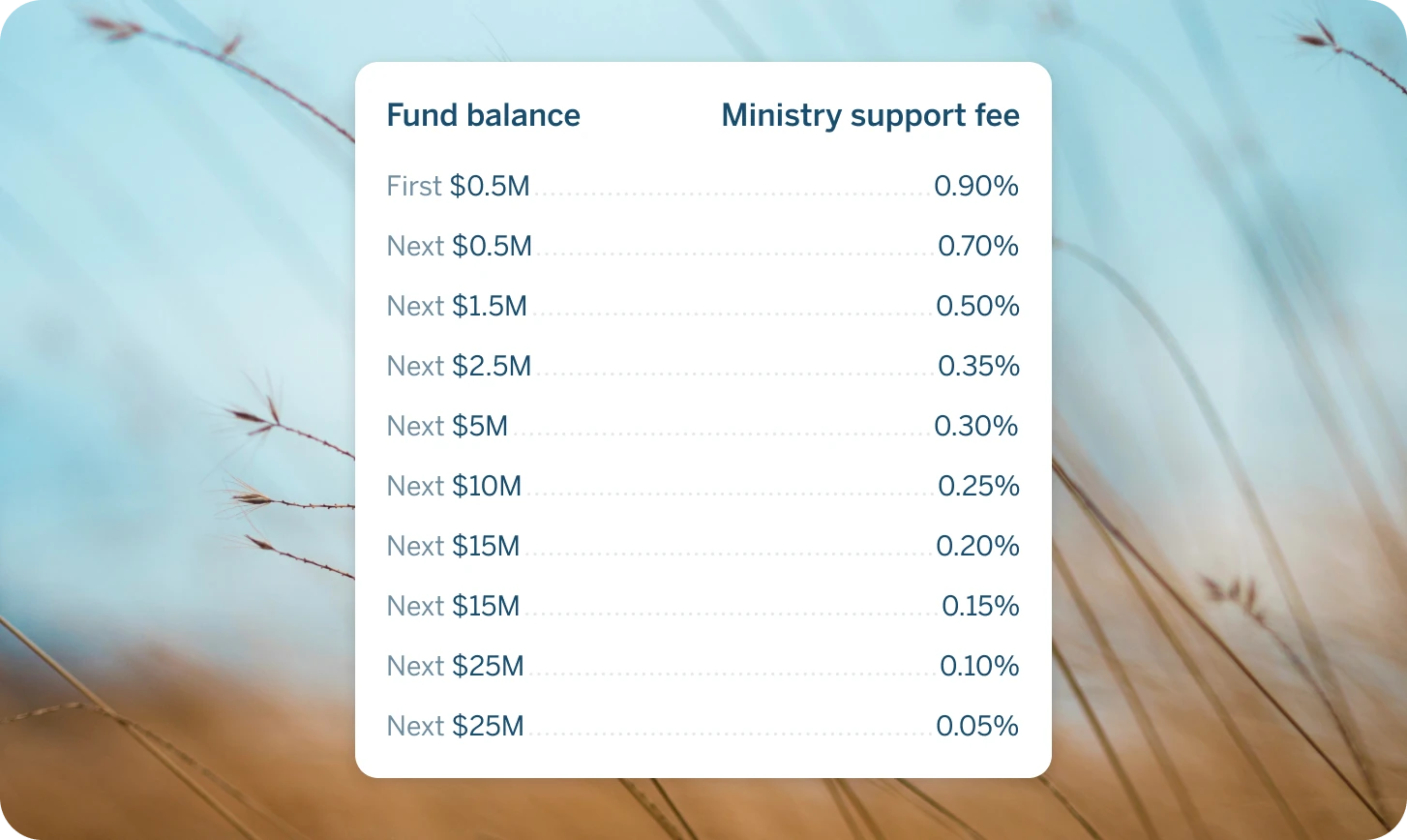
Tiered ministry support fees based on fund balance, clearly outlined on a modern card design.
Single-Charity Fund
What is a Single-Charity Fund?
Sometimes, you want to make a gift to one charity, but giving the money in a lump sum may not be the right choice. A Single-Charity Fund is designed for givers who want to support one charitable organization over time. Rather than making a one-time gift directly to the charity, you can give to your fund when the timing is right and recommend grants that align with your charitable strategy and the organization’s evolving needs.
Like a Giving Fund, a Single-Charity Fund allows you to make additional gifts over time and choose from NCF’s values-aligned investment options while charitable assets remain in the fund. Unlike a Giving Fund, however, grants may only be made to the single charitable organization you choose.
Who can open a Single-Charity Fund?
Individuals, families, and charitable organizations can open a Single-Charity Fund to support one named charity over time.
Opening a Single-Charity Fund

To open a Single-Charity Fund, complete the PDF application and submit it to NCF by email, fax, or mail. As part of the application, you’ll choose a name for your Single-Charity Fund, provide your contact information, and name the charitable organization you want to receive grants from the fund. (The charity you choose must be an approved NCF grantee. If it isn’t, you can submit a charity for NCF approval.) NCF must approve the named charity before the Single-Charity Fund can be established.
Once the Single-Charity Fund is established, you’ll receive the fund information and instructions for accessing our secure online giving site. From there, you can make additional gifts, choose from NCF’s investment options, grant to the charity, and track your fund activity, all in one place.
Gifts to a Single-Charity Fund
Funding a Single-Charity Fund works much like funding a Giving Fund. You can give cash or appreciated publicly traded securities while choosing when and how to support your chosen charity. For more information about other ways to give to your fund, publicly traded securities, receipts, and transfer instructions, see the Gifts to a Giving Fund section.
Investment options for a Single-Charity Fund
Like a Giving Fund, a Single-Charity Fund offers access to NCF’s values-aligned investment options while charitable assets remain in the fund. Learn more in the Investment options for a Giving Fund section.
Granting from a Single-Charity Fund
Granting from a Single-Charity Fund works much like granting from a Giving Fund. You can recommend one-time or recurring grants to the named charity whenever you’re ready, giving you the flexibility to support the organization over time. For additional information about recommending, scheduling, and processing grants, see the Granting from a Giving Fund section.
Succession planning for a Single-Charity Fund
Because a Single-Charity Fund is designed to support one named charitable organization, succession planning works differently than it does for a Giving Fund. Because your options depend on your charitable goals and the needs of the designated charity, we encourage you to work with your local NCF team to create a succession plan that reflects your generosity intentions.

Managing a Single-Charity Fund
A Single-Charity Fund at NCF has the same online access, roles, and features as a Giving Fund. To learn more about the fund settings available to you, see the Managing a Giving Fund section.
What does a Single-Charity Fund cost?
A Single-Charity Fund follows the same cost assessment as a Giving Fund. For additional information about the ministry support fee, see the Cost of a Giving Fund section.
Designated Fund
What is a Designated Fund?
A Designated Fund is a charitable giving solution specifically for qualified charitable distributions (QCDs) from an Individual Retirement Account (IRA). It allows eligible individuals to support one designated charitable organization while choosing when grants are distributed to that charity.
When you establish a Designated Fund, you’ll identify the charitable organization that will receive grants from the fund. Once your QCD is received, you can recommend one-time or recurring grants based on the charity’s needs and your charitable goals.
Unlike a Giving Fund, a Designated Fund is not a donor-advised fund and may only be used to support the single charitable organization designated when the fund is established.
Who is eligible for a Designated Fund?
Individuals who are eligible to make QCDs from their IRA can open a Designated Fund. If you’re age 70½ or older, you may make a QCD directly from your IRA to a Designated Fund, subject to annual IRS limits.
A Designated Fund provides flexibility to support one designated charitable organization while allowing you to choose when grants are distributed. Charitable assets may also be invested through NCF’s investment options before they are granted, helping you align distributions with the organization’s needs and your charitable goals.
QCDs are also commonly referred to as IRA charitable rollovers. Because tax rules governing QCDs may change, we encourage you to consult your tax advisor regarding your eligibility and applicable annual limits.

Investment options for a Designated Fund
While charitable assets remain in the Designated Fund, they may be invested through NCF’s investment options before being granted to the designated charity. Your local NCF team can help you understand the investment options available for your Designated Fund and answer any questions about selecting or updating your investment selections. Learn more in the Investment options for a Giving Fund section.
Granting from a Designated Fund
Granting from a Designated Fund works much like granting from a Giving Fund. You can recommend one-time or recurring grants to the designated charity whenever you’re ready, giving you the flexibility to support the organization over time. For additional information about recommending, scheduling, and processing grants, see the Granting from a Giving Fund section.
Succession planning for a Designated Fund
Because a Designated Fund is established to support a single identified charitable organization, its succession planning differs from that of a Giving Fund. A succession plan can provide for the remaining balance to continue supporting that organization over time or name a successor to continue managing the existing Designated Fund. We encourage you to work with your local NCF team to discuss the options available for your Designated Fund.
Managing a Designated Fund
A Designated Fund is managed through NCF’s secure online giving platform, using many of the same online features available for a Giving Fund. The information in the Managing a Giving Fund section also applies to Designated Funds, except as described below.
Because a Designated Fund supports one designated charitable organization, grant recommendations are limited to that organization, and transfers to other NCF funds are not available.
What does a Designated Fund cost?
A Designated Fund follows the same cost assessment as a Giving Fund. For additional information about the ministry support fee, see the Costs of a Giving Fund section.
Giving complex assets and Complex Gift Account (CxGA)
What is a CxGA?

NCF does not receive complex asset gifts; however, those gifts can be made to one of NCF’s affiliated ministries.
A CxGA is created by the affiliated ministry as a vehicle for administering complex asset gifts. Because gifts like privately held business interests, real estate, and other non-cash assets often require specialized review, legal documentation, and liquidation, they are received by the NCF affiliated ministry rather than into a Giving Fund. Throughout the process of making a complex gift, your local NCF team walks alongside you and your professional advisors to help facilitate the gift.
What are NCF’s affiliated ministries?
NCF’s affiliated ministries are part of our family of organizations, and each play a specialized role in receiving, administering, and ultimately liquidating complex asset gifts. These affiliated ministries – including NCF Charitable Asset Trust (NCAT), NCF Real Property, Inc. (NCFRP), and NCF Charitable Trust (NCT) – are each independent, tax-exempt public charities.
The NCF affiliated ministry that receives your gift becomes the charitable owner of the asset and is responsible for administering and liquidating it in accordance with applicable legal and tax requirements. Your local NCF team remains your primary point of contact throughout the process.
Types of complex asset gifts in a CxGA
An NCF affiliated ministry can receive complex assets, like real estate, business interests, private investments, life insurance, or oil, gas, and mineral rights and place them in a CxGA.
How does a CxGA work?
Unlike a Giving Fund, with a CxGA, the NCF affiliated ministry administers the asset once the CxGA is established and throughout the ownership and sale process, working with you and your professional advisors as needed. While the asset is held in a CxGA, givers receive summaries of the activity of the CxGA but do not hold any advisory rights to it.
As distributions are made – either ongoing owner distributions or distributions after a sale – the proceeds are deposited into the CxGA. Those proceeds are used to satisfy any applicable taxes, administrative costs, accrued expenses, escrows, and other obligations associated with the gift.
Once those obligations have been met, the NCF affiliated ministry makes the remaining net charitable proceeds available to support your charitable goals. Depending on your gift structure, the net proceeds may be granted to an NCF grantmaking vehicle, like a Giving Fund, Single-Charity Fund, or Supporting Organization, where they can be invested or granted to charities.
What is a ministry grant?
A ministry grant is a one-time charitable gift made in conjunction with a complex asset gift to support NCF’s ministry. Ministry grants help make it possible for NCF to continue serving families and facilitating complex asset gifts. As previous givers have made this work possible for you, we invite you to consider doing the same for those who come after you.
What does a CxGA cost?
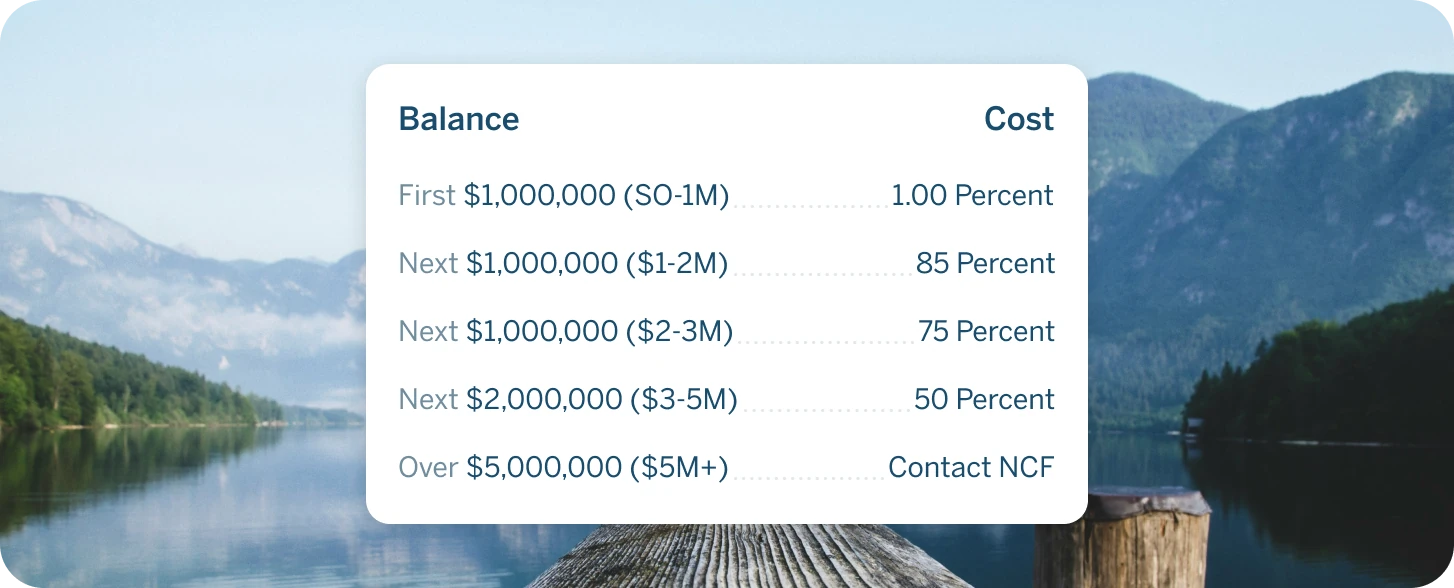
Complex asset gifts often require ongoing administration before and after a sale, including legal, accounting, tax, compliance, and asset management services. To help cover these ongoing costs, CxGAs are subject to an ongoing cost allocation (OCA) assessed based on the account’s value using a tiered schedule.
If your account balance exceeds $5 million, your local NCF team will work with you to determine the appropriate OCA.
The rates below represent the annual cost that accrues daily and is assessed monthly. NCF’s affiliated ministry uses the cash flow from the gifted asset’s distributions to satisfy the OCAs for all CxGAs. To eliminate partial-month calculations, the OCA begins on the first day of the seventh month after the gift date (e.g., for a gift made on any day in December, the OCA begins on July 1).
Testamentary giving
What is Testamentary giving?
Testamentary giving allows you to continue supporting the ministries and causes you care about by directing assets to your Giving Fund after your lifetime. By naming your Giving Fund as a beneficiary through your estate plan, you can continue your charitable goals while also potentially reducing taxes so more remains for giving.
After the charitable gift is received, the proceeds are added to your Giving Fund and distributed according to the succession plan associated with your fund. This allows your generosity to continue supporting your favorite charities or future generations of your family’s generosity through your Giving Fund.
How does testamentary giving work?

You can work with your attorney or advisor to designate your Giving Fund as the beneficiary of all or part of your estate after your lifetime. This may be accomplished through a:
- Bequest in a will or trust
- Beneficiary designation of an IRA or other retirement account
- Beneficiary designation of a life insurance policy
- Payable or transferable on a death beneficiary designation of a bank or brokerage account
- Life income arrangement (like a Charitable Gift Annuity or a charitable remainder trust) or a testamentary charitable lead trust, etc.
Consult your legal or tax advisors for guidance with establishing testamentary instructions.
To learn more about testamentary giving, contact your local NCF team. We’ll help you explore your options, discuss your long-term charitable goals, and develop a plan that reflects your generous intentions.
Can I include my Giving Fund in my estate documents?
Yes. If you and your advisor determine that testamentary charitable giving is appropriate for your financial and philanthropic planning, name your Giving Fund in your estate documents by completing and including the following paragraph:
National Christian Charitable Foundation, Inc. (TIN# 58-1493949, 1150 Sanctuary Pkwy, Suite 350, Alpharetta, GA 30009) or one of its affiliated ministries (including but not limited to NCF Charitable Assets Trust), as may be determined by NCF, subject to applicable governing instruments, policies and procedures, as amended from time to time. This distribution is designated for The ____________________Giving Fund (#___________).
For beneficiary designation forms with smaller fields or boxes, like on IRAs, retirement plans, life insurance, bank or brokerage accounts:
National Christian Charitable Foundation, TIN #58-1493949, for The ______________________ Fund, #________.
What does testamentary giving cost?
Testamentary gifts will be subject to NCF’s annual ministry support fee. On receipt of a testamentary gift, an initial assessment of up to 0.90 percent will apply, based on the complexity of the gift and the administration required. If the initial assessment is insufficient to cover the costs associated with the estate settlement, distribution, and administration of the testamentary gift, NCF reserves the right to collect additional grant dollars sufficient to cover those costs.

Charitable Gift Annuity (CGA)
What is a CGA?
A CGA is a simple arrangement that combines a charitable gift with an annuity. You make an irrevocable gift to NCF, part of which may be tax-deductible, and then you or someone you choose receives fixed annuity payments each year for life. The charitable portion of your gift is designated to support the charities of your choice.
How does a CGA work?
You make an irrevocable gift of $25,000 or more to NCF (or one of its affiliated ministries). The CGA can be funded with cash, publicly traded securities, a QCD from an IRA, or other assets. A portion of the gift is usually eligible for a charitable tax deduction, and the other portion funds an annuity. The annuity makes payments to you and/or someone you designate (the annuitant).

When CGA gifts are made to NCF, NCF issues the annuity and is obligated to make lifetime payments to the annuitant. Traditionally, CGAs don’t benefit the charity until the end of the annuitant’s lifetime when the payments stop; however, NCF manages its program differently.
Our CGA program is carefully managed to ensure the annuity payments can be made while also benefiting charity at the beginning. This often involves purchasing commercial annuities from large insurance companies, a process called reinsurance. It provides an extra layer of protection for those payments, and it has the added benefit of making the charitable portion available for granting shortly after the CGA is established. This lets you begin supporting the charities you care about during, rather than after, your lifetime.
Cost of a CGA
When NCF reinsures a CGA, it will use some of the funds from your gift to cover the cost of reinsurance. In most cases, we then do two things with the net balance:
- Almost all states allow NCF to place a portion of the gift in a fund for you to begin supporting your favorite churches and charities. This amount is determined by an actuarial calculation based on the annuitant’s life expectancy and federal and state laws. Members of our CGA team will evaluate this with you before you fund your CGA.
- NCF retains the remaining balance to fund the operations of its CGA program. On the rare occasion when the remaining balance is less than $500 or 1 percent of the original contribution amount, NCF will need to reduce the charitable portion so that it can retain $500 or 1 percent (whichever is greater).
Supporting Organization (SO)
What is an SO?
An SO is a tax-exempt public charity that may be the right solution if your charitable goals extend beyond the flexibility of a Giving Fund. It provides individuals, families, and businesses with more complex philanthropic goals a customized charitable structure that offers greater flexibility in managing charitable assets and investments, making grants, funding certain charitable expenditures, and involving family members in long-term charitable stewardship, while also benefitting from NCF’s charitable expertise and administrative support.
Because every SO is unique, your local NCF team will work closely with you to determine whether this structure aligns with your charitable goals and help you design an approach that best fits your generous vision.
How does an SO work?
Each SO is established as a separate public charity that supports NCF’s charitable mission. It’s governed by its own board of directors, usually composed of giver and NCF representatives. The board establishes the organization’s charitable purpose, oversees its charitable assets, and approves grants and other charitable activities.
NCF typically provides administrative, investment, accounting, compliance, and operational support, so the SO board can focus on advancing the organization’s charitable mission.
Cost of an SO
Because every SO is unique, costs are customized based on the services and support the SO requires. Your local NCF team will discuss the applicable costs during the planning and establishment process, so you have a clear understanding of the services provided and the associated expenses.

Solutions for charities
Single-Charity Fund
What is a Single-Charity Fund?
A Single-Charity Fund is a charitable fund established at NCF to support one named charitable organization. The fund may receive gifts from your organization, your donors, or both. While charitable assets remain in the fund, they can be invested before grants are distributed to your organization over time.
A Single-Charity Fund gives your organization an efficient way to receive charitable gifts, build resources for future ministry through invested charitable assets, and offer donors additional flexibility in how they support your mission.
Who can open a Single-Charity Fund?
Your organization can establish a Single-Charity Fund dedicated exclusively to your mission. Individual donors may also establish their own Single-Charity Funds to support your organization.
Opening a Single-Charity Fund
To open a Single-Charity Fund, complete the PDF application and submit it to NCF by email, fax, or mail. As part of the application, you’ll choose a name for your Single-Charity Fund, provide your organization’s contact information, identify your organization as the recipient of grants from the fund, and select the fund settings that best support your charitable goals.
Once your Single-Charity Fund is established, you’ll receive instructions for accessing NCF’s secure online site. From there, you can make contributions, choose from NCF’s investment options, recommend one-time or recurring grants to your organization, and track your fund activity in one place.
How are gifts made to a Single-Charity Fund?
Funding a Single-Charity Fund works much like funding a Giving Fund. Your organization and your supporters can give cash or appreciated publicly traded securities to the fund. For more information about methods for giving to your fund, publicly traded securities, receipts, and transfer instructions, see the Gifts to a Giving Fund section.
Inviting others to give to a Single-Charity Fund

A Single-Charity Fund can include a donate button that makes it easy for supporters to give directly to your fund online. Whether they’re making a one-time gift or supporting your organization over time, the donate button provides another convenient way to invest in your mission.
You can share your unique donate button through email, on your website, in digital communications, or anywhere you’d like to invite others to support your organization. To access your donate button, log in to our secure online site and select Settings. Use of a donate button is subject to the requirements for eligible donations outlined in our Program Agreementopens in a new tab under “Donate button.”
Investment options for a Single-Charity Fund
Like a Giving Fund, a Single-Charity Fund offers access to NCF’s values-aligned investment options while charitable assets remain in the fund. Learn more in the Investment options for a Giving Fund section.
Granting from a Single-Charity Fund
Granting from a Single-Charity Fund works much like granting from a Giving Fund. You can recommend one-time or recurring grants from the fund to your organization whenever they’re needed. For additional information about recommending, scheduling, and processing grants, see the Granting from a Giving Fund section.
Succession planning for a Single-Charity Fund
Because a Single-Charity Fund supports a single named charitable organization, its succession planning differs from that of a Giving Fund. A succession plan can provide for the remaining balance to continue supporting your organization over time, or you can name a successor to continue managing the existing Single-Charity Fund. We encourage you to work with your local NCF team to discuss the available options.
Managing a Single-Charity Fund
A Single-Charity Fund is managed through our secure online site using many of the same online features available for a Giving Fund. The information in the Managing a Giving Fund section also applies to Single-Charity Funds, except as described below.
Because a Single-Charity Fund supports one specified charitable organization, grants are limited to your organization. Transfers to other NCF funds are not available.
What does a Single-Charity Fund cost?
A Single-Charity Fund has the same cost structure as a Giving Fund. For this information about the ministry support fee, see the Cost of a Giving Fund section.

Charitable Gift Annuity Administrative Services (CGA Services)
What are CGA Services?
CGA Services allow your organization to offer CGAs to your donors without administering the program yourself. Through this service, NCF provides the specialized administration, compliance, and ongoing support needed to establish and manage CGAs, allowing your organization to offer this planned giving solution without administering it internally.
By working with NCF, your organization can offer donors another planned giving option while relying on NCF’s experience administering CGAs and navigating the legal, operational, and regulatory requirements they involve.
How do CGA Services work?
When a donor expresses interest in establishing a CGA, your organization introduces the opportunity and connects the donor with NCF. We answer questions, work with your organization and the donor to establish the CGA, and complete the necessary documentation.
Once the CGA is established, we administer the agreement throughout its lifetime, including issuing annuity payments, providing required tax reporting, and managing the ongoing administration of the CGA. Throughout the process, your organization remains engaged with the donor, while we provide the specialized administration needed to support the program.
What do CGA Services cost?
When NCF reinsures a CGA, it will use some of the funds from your donor’s gift to cover the cost of reinsurance. In most cases, we then do two things with the net balance:
- Almost all states allow NCF to place a portion of the gift in a fund for your donor to begin supporting your organization. This amount is determined by an actuarial calculation based on the annuitant’s life expectancy and federal and state laws. Members of our CGA team will evaluate this with your donor before they fund their CGA.
- NCF retains the remaining balance to fund the operations of its CGA program. On the rare occasion when the remaining balance is less than $500 or 1 percent of the original contribution amount, we will need to reduce the charitable portion so that it can retain $500 or 1 percent (whichever is greater).

Solutions for advisors
NCF works with advisors to help clients accomplish their giving goals. We provide charitable expertise, giving solutions, and administrative support, allowing advisors to remain the primary relationship for their clients.
Separately Managed Accounts (SMAs)
An NCF giver with a fund balance of $300,000 or more may recommend you as a qualified investment advisor to provide investment management services for the assets in their Giving Fund. Once you’re approved, you can manage your client’s Giving Fund assets and help them align their personal financial planning with their charitable giving goals from a single, unified perspective. SMAs are best suited for your clients who have large ongoing fund balances, longer-term charitable giving horizons, and the desire for their fund balance and charitable impact to grow over time.
How NCF works with professional advisors
NCF works alongside financial advisors, attorneys, accountants, and other trusted professionals to help givers steward generosity wisely. Whether your client is making a current gift, planning for future giving, or exploring charitable strategies, we can help provide resources, planning support, and experience in charitable giving to help you serve your clients with confidence.
Our experienced charitable giving professionals can help you identify giving opportunities, provide you with charitable gift illustrations, answer your technical questions, and support your client conversations about tax-wise giving. By working together, we can help you and your clients develop charitable solutions that reflect their values and accomplish their philanthropic goals.
Summary of costs
The following are the costs and assessments applicable to NCF grantmaking vehicles.
Ministry support fee
- Assessed on a daily basis based on the total fund balance. This amount is based upon the daily fair market value of the assets. (Minimum $30 per month unless the balance is zero).
- Giving Fund, Single-Charity Fund, Designated Fund
Grant cost allocation
- Assessed for wired grants ($25), grants requiring special handling ($40), or other unusual processing expenses or costs (varies).
- Giving Fund, Single-Charity Fund, Designated Fund
Ongoing cost allocation (OCA)
- Applied to complex assets that are not liquidated in the short term.
- Complex Gift Account
Ministry grant
- A percentage of the fair market value of each gifted asset as determined by the contributor and the NCF representative for the gift.
- Complex Gift Account
Testamentary gifts
- Testamentary gifts will be subject to NCF’s annual ministry support fee. Upon receipt of a testamentary gift, up to a .90 percent initial assessment may be applied by NCF to help cover costs associated with receiving and administering the gift.
- Giving Fund, Single-Charity Fund, Designated Fund
Other costs
- Costs applied when NCF provides customized administrative, grant management and investment management support for Supporting Organizations and Charitable Gift Annuities. (Amount as agreed when solution is selected.)
- Supporting Organizations, Charitable Gift Annuities
Important note about the purpose of this document
This guide generally describes how National Christian Charitable Foundation, Inc. and its supporting organizations operate in pursuit of NCF’s charitable mission and how givers, charities, and advisors interact with NCF. NCF, at its discretion, may modify this document at any time and without prior notice. This guide will be updated from time to time but may not be current at times, either with respect to NCF’s policies and procedures or applicable law, as both are subject to change.
No part of this document constitutes an agreement between NCF and any giver or any other person or otherwise binds any person. Any statement in this document regarding tax or legal rules, authorities, concepts, or consequences is informational only, represents only general presentation of the subject matter and is not provided as authoritative or as legal, financial, or tax advice. Readers should not rely on any tax or other legal information provided herein but should instead consult their own legal or other professional tax counsel.