4 relatable lessons on giving from the early church

We look to the Bible for broad spiritual lessons when it comes to money, and it’s a great source for that purpose. But, if we pay close enough attention, we can also discover practical and tactical financial best practices within the text – and the book of Acts is a great place to start.
Luke, the physician who wrote the book of Acts, as well as the Gospel that bears his name, was adept at “following the money.” Luke’s account of the life of Jesus has more financial stories and details than any of the other Gospels.
Similarly, the book of Acts gives us precious glimpses into the financial world of the early Church. Luke seems to suggest that the spiritual world and the financial world are more intertwined than we might think.
In Acts 4, Luke records that the early Church’s growth was fueled by two giving trends that seem strikingly modern: giving assets, and collaborative giving. While your local NCF team operates in the 21st century, in some ways they are simply running a play from the tried-and-true, 2,000-year-old playbook from Acts.
All the believers were one in heart and mind. No one claimed any of their possessions was their own, but they shared everything they had. With great power the apostles continued to testify to the resurrection of the Lord Jesus. And God’s grace was so powerfully at work in them all that there were no needy persons among them. For from time to time those who owned land or houses sold them, brought the money from the sales and put it at the apostles’ feet, and it was distributed to anyone who had need.
Acts 4:32-35
In the chapter that follows, Luke shares two contrasting case studies – Barnabas (a positive example) and Ananias and Sapphira (a sinful, failed example). Finally, in Chapter 6 we learn of the need for greater administrative capacity for managing these gifts effectively.
If you’d like, pause now and read Acts 4-6, keeping an eye out for financial and administrative details as the story progresses.
What can we learn from these chapters?
The spiritual impact of our generosity depends on practical tasks
Gift planning, role clarity, and financial administration
We sometimes recoil when realizing how much planning it takes to get our giving strategy in motion. However, the biblical witness is that such planning is key to a healthy, thriving church.
It would have taken significant work to liquidate an asset as described in this text. Once the funds were prepared, the phrase “put it at the Apostles’ feet” indicates a formal legal transfer of assets.
This was no casual handover of a bag of coins – it was the structured placing of kingdom assets into a trusted channel for impact. Imagine the journey of the giver – a gentle nudge from the Holy Spirit followed by a season of wrestling, doubts, and prayer. Then that would be followed by a few weeks of action to make the gift a reality. Finally, the formal handover of proceeds to the Apostles would fuel the church’s growth.
We can also infer from Chapters 5-6 that there was a structured, daily distribution of food to the needy in the community. From 1 Timothy 5:9, we learn that the early church even developed fairly sophisticated rules about eligibility.
While the Apostles initially took in the funds and administered the gifts, the load quickly became too much to bear. Chapter 6 describes a process of recruiting administratively gifted leaders to carry out the community’s benevolence program.
Spreading the Good News and supporting the fledgling church required far more than “writing a check.” There were assets mobilized, administrative talents leveraged, and logistical problems solved along the way. This doesn’t sound too different from what we do today.
Giving takes a bit of work. But there is often joy in this work, and it is a worthy spiritual task. The work we do to make gifts happen facilitates the expansion of God’s kingdom. Giving is worship, and we’re called to do it excellently (2 Corinthians 8:7).
God’s calling for our giving may require asset-based strategies
Supplementing regular cash-based giving
As some super-users of NCF have joked, “Friends don’t let friends give cash.” While the early Christians didn’t have the same tax reasons to do non-liquid gifts as we do, the size of their mission meant that cash giving alone wasn’t enough to get the job done.
From time to time, a well-off believer would sell a non-liquid asset in order to boost the work of the Church, Luke explains. Reading carefully, it is clear that this is not everyone selling everything they owned; rather, there were occasional and quite meaningful gifts made as God led his affluent disciples to give generously.
Collaborative, generous communities foster tremendous spiritual impact
Harnessing the power of community of generosity
As the early Christians faced the world, they saw immense spiritual and physical poverty all around them. Rather than acting as individual givers, they came together and sought collective impact with their giving.
Could one giver have administered the daily distribution of food to widows? No. But, acting in unison, many believers accomplished this task together. The loving community they formed – feeding the hungry, welcoming children, and worshipping in joyful unity – allowed the early Jesus communities to spread.
In this milieu of collaborative giving and spiritual devotion, Barnabas took a bold leap of faith into generosity. This initial step in his discipleship journey would propel him forward, as he became a partner to Paul and one of the most critical leaders in the early days of the missionary expansion of the Church.
Giving generously, in community with other believers can facilitate leveraged impact for God’s kingdom. And it might just propel you into a new calling you never anticipated, like it did Barnabas.
When undertaking a major giving effort, expect roadblocks, personal challenges, and sinful behaviors
But, don’t let them keep you from God’s purposes.
The early Church was not immune to the full range of problems that we face today. In the case of Ananias and Sapphira, givers lied about a freely given gift, posturing pridefully as more generous than they actually were.
While their gift was generous, their lying, prideful spirit was literally a mortal sin. God would not allow his young church to be corrupted by givers who gave for personal glory and for the praise of men.
On the ministry side, we observe bickering and infighting over who was getting more food. (It’s like a heated argument at the Wednesday-night church potluck.) Can you imagine being the giver who enabled food distribution, only to see everything devolve into partisan fighting over ration sizes?
Thankfully, problems with givers and problems with ministries did not keep God’s kingdom from advancing. When we face similar issues today, we should not back down from our calling to give generously and to serve faithfully.
May we take the financial lessons of Acts 4-6 to heart, as we give together for the advancement of the gospel. Please consider taking a next step of your own in response to this article.
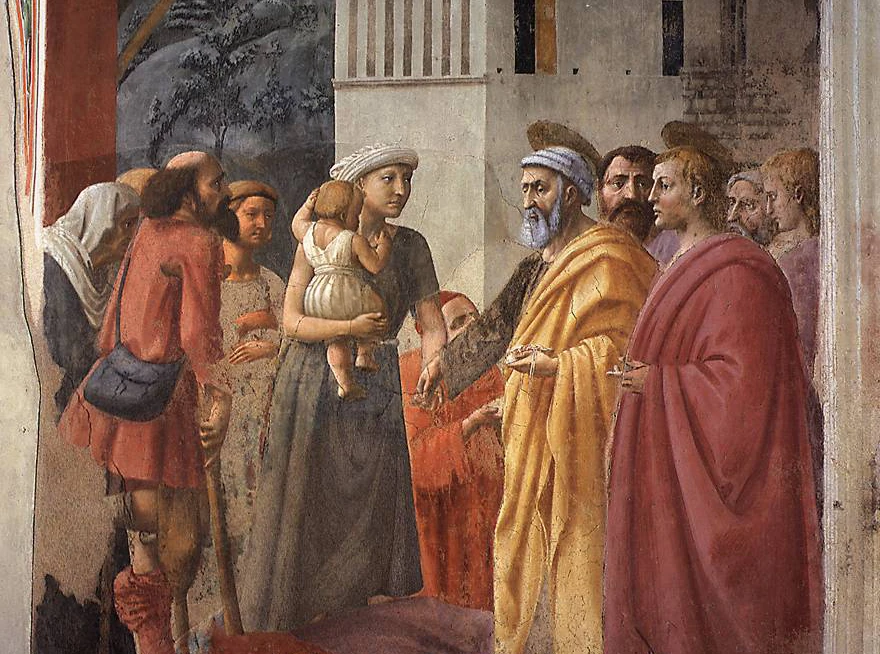
Photo: Wikimedia Commons, “The Distribution of Alms and the Death of Ananias,” Masaccio
 God’s first gift wasn’t money
 Carry one another’s burdens: 8 ways to help those who are hurting
 How giving transforms us
 Is Jesus enough for you?