The state of pastors 2024

In 2024, most pastors have faced a multitude of issues they could never have anticipated, and it’s weighing on them. Together, a radically shifting culture, an intense political climate, concerns about new technologies, and a multi-year, global pandemic have produced a tsunami of challenges they can’t (and shouldn’t have to) handle alone.
Add to that the fact that pastor credibility is downopens in a new tab (and pastors sense it) and you find church leaders who report decreased confidenceopens in a new tab, doubt about their callingopens in a new tab, and a decline in various markers of well-being.opens in a new tab
A 2024 report from Barna Groupopens in a new tab, based on research conducted between 2015 and 2023, details these and other alarming trends among senior pastors but also offers a glimmer of hope: By late 2023, the numbers show slight improvement over 2022 on a number of fronts.
The weight of a pastor’s role
Besides everything else, I face daily the pressure of my concern for all the churches. – Paul, 2 Corinthians 11:28
The biblical description of a pastor’s role is weighty. They’re called to live exemplary lives, to demonstrate care for their families, to live in a way that is above reproach (Titus 1:7, 1 Timothy 3:2-4). They must model hospitality, self-control, and spiritual discipline (all while often feeling like they live in a fishbowl). They will answer to God for how they’ve cared for their “flocks,” and most sense this responsibility deeply.
The overall weight of these obligations was the main reason pastors reported to Barna in 2022opens in a new tab that they’d considered leaving ministry altogether. And reflective of the overwhelming nature of the responsibility is a lack of flourishing in critical areas of life.
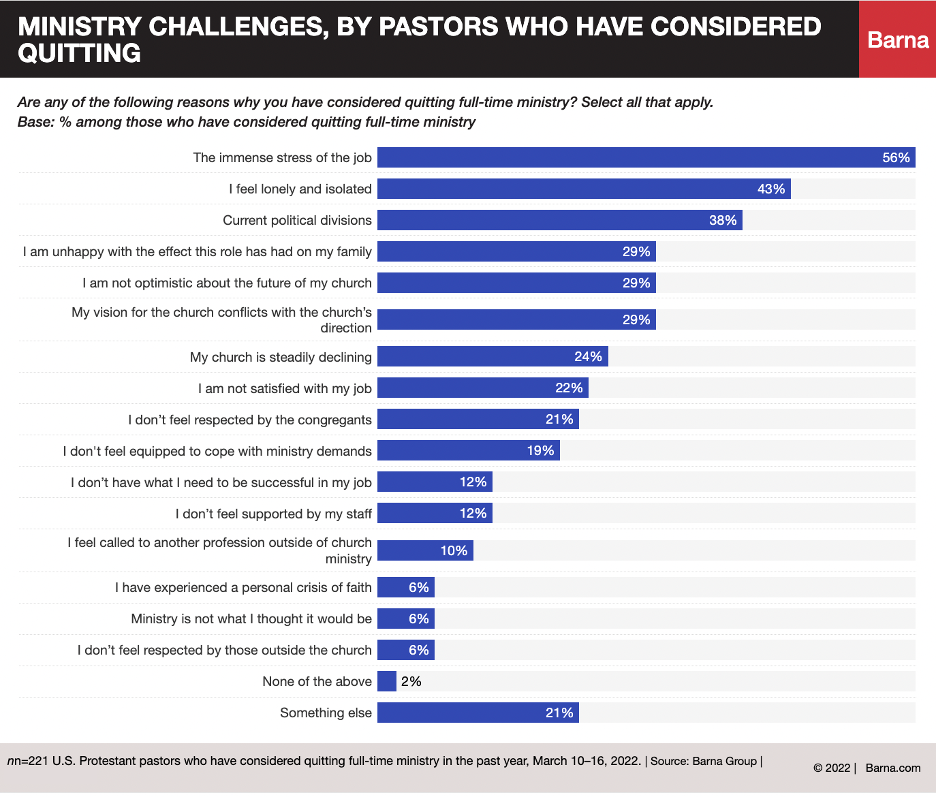
In late 2023, when Barna polled 523 Protestant senior pastors of varying ages and denominations (including nondenominations), they found that:
One-third had considered quitting in the last year, 60 percent had significantly doubted their calling, and 25 percent said they’d seriously doubted their faith. Most soberingly, Barna says, “Nearly one in five Protestant senior pastors in the U.S. (18%) say they have contemplated self-harm or suicide within the past year.”
And between 2015 and 2023, significant measures of pastor wellness showed danger signs.
In 2015, 24 percent of pastors reported excellent physical well-being. But in 2023, that same number was just 11 percent. In the same time period, those reporting excellent mental and emotional well-being plummeted from 39 to 14 percent. Pastors feeling they had excellent overall quality of life dropped from 42 to 19 percent, and pastors who believe they have “true friends” decreased from 34 to 19 percent. Over the same period, pastors who ranked the respect they feel from their communities as excellent fell from 22 to just 7 percent.
The responsibility of the Church
The Bible is clear that church members are all part of the body, and the church has a responsibility to their pastors. We don’t talk about this a lot, but the message of Scripture is clear:
We ask you, brothers, to respect those who labor among you and are over you in the Lord and admonish you, and to esteem them very highly in love because of their work. Live in peace with each other.
1 Thessalonians 5:12-13
Obey your leaders and submit to them, for they are keeping watch over your souls, as those who will have to give an account. Let them do this with joy and not with groaning, for that would be of no advantage to you.
Hebrews 13:17
Church leaders are to be given a double measure of respect (1 Timothy 5:17), but research shows that isn’t happening as much as it used to. And beyond respect, we’re called to make their jobs lighter.
So, what can we do? The answers seem to fall into two different categories. We’ll separate them out here.
How church members can help
While your pastor is the one who will give an account for how he led the church, each member of the body plays a role. Here are just a few things you can do to play your role.
- Get along, and help others do the same
This one is scriptural. Just look at the last sentence in each of the verses above. Refuse to be part of any petty arguments. Work to be a peacemaker where you can. Find out who might be able to help (maybe other church leaders or a professional counselor on staff) if you find yourself in a situation that is too difficult for you to handle alone. - Volunteer
Every church needs volunteers, and it is a stress on church leaders when members don’t join in the work. Take a test to find your spiritual gifts, or consider offering to help with specific skills you know you have. If no ministry exists yet that matches your skills, you might offer to start one. And if not, try volunteering in an area you might not have considered before. If you don’t find joy in it, try something else. - Share stories of life change
If something you’ve learned at church has changed the way you live or encouraged you to help someone else, write it down and send it to the church or tell a pastor directly. While comments like, “That was a great sermon today,” tend to be less than helpful, evidence their teaching is helpful is another story! Bringing about life change was a primary motivation for most pastors when they began their careers. Hearing it’s happening as a result of a sermon or the church’s ministry affirms the calling God gave them.
How church leaders can help
Elders, deacons, and other church leaders may be able to do what those who aren’t as close to the pastor cannot. If you are in a leadership role or a pastor-advisory role in your church, pray to discern if you might be able to help your pastor with any of these:
- Read The Resilient Pastoropens in a new tab by Glenn Packiam
In this book, Packiam talks about what he calls a “constellation of support” pastors need. This is a group comprised of a true friend (who is not a member of their church or family), a peer (who pastors another church), a sage (a mentor or older, experienced friend), a healer (doctor or mental-health professional), and a king (someone who speaks plainly, is not afraid to say no, and holds the pastor accountable). - Advocate for a fair salary
If you believe your pastor is underpaid, advocate for a livable wage. In 2023, only 41 percent of pastors reported they were financially flourishing (and this number was much lower among younger pastors). Pastors who are struggling to provide for their families may have a much harder job carrying the weight of their responsibility to the church. If your pastor is making a fair wage but still struggling financially, hire a financial counselor to help them. - Protect your pastor’s private time
Pastors need private time to invest in their personal spiritual development, but, in 2023, 38 percent reported finding that difficult or very difficult to do. And pastors need time alone with family and friends who aren’t part of the church. Yet almost three out of five pastors (59%) reported that they don’t have a private life because their closest relationships are impacted by their calling.
- Help your pastor find good physical and mental-health care
Don’t just encourage, and don’t wait for a crisis. Preventive care is important. Ask around to find the best medical and mental-health providers in your area and share those names. If you know leaders of other churches in your area, ask what they do to ensure the health of their pastors and which providers they recommend.
- Don’t wait for pastors to ask for help
The data indicate pastors are unlikely to seek help, even when they know they need it. In 2022, when Barna asked a group of senior pastors if they get help from a professional mentor, therapist, or professional counselor, 65 percent said they did not.
A glimmer of hope
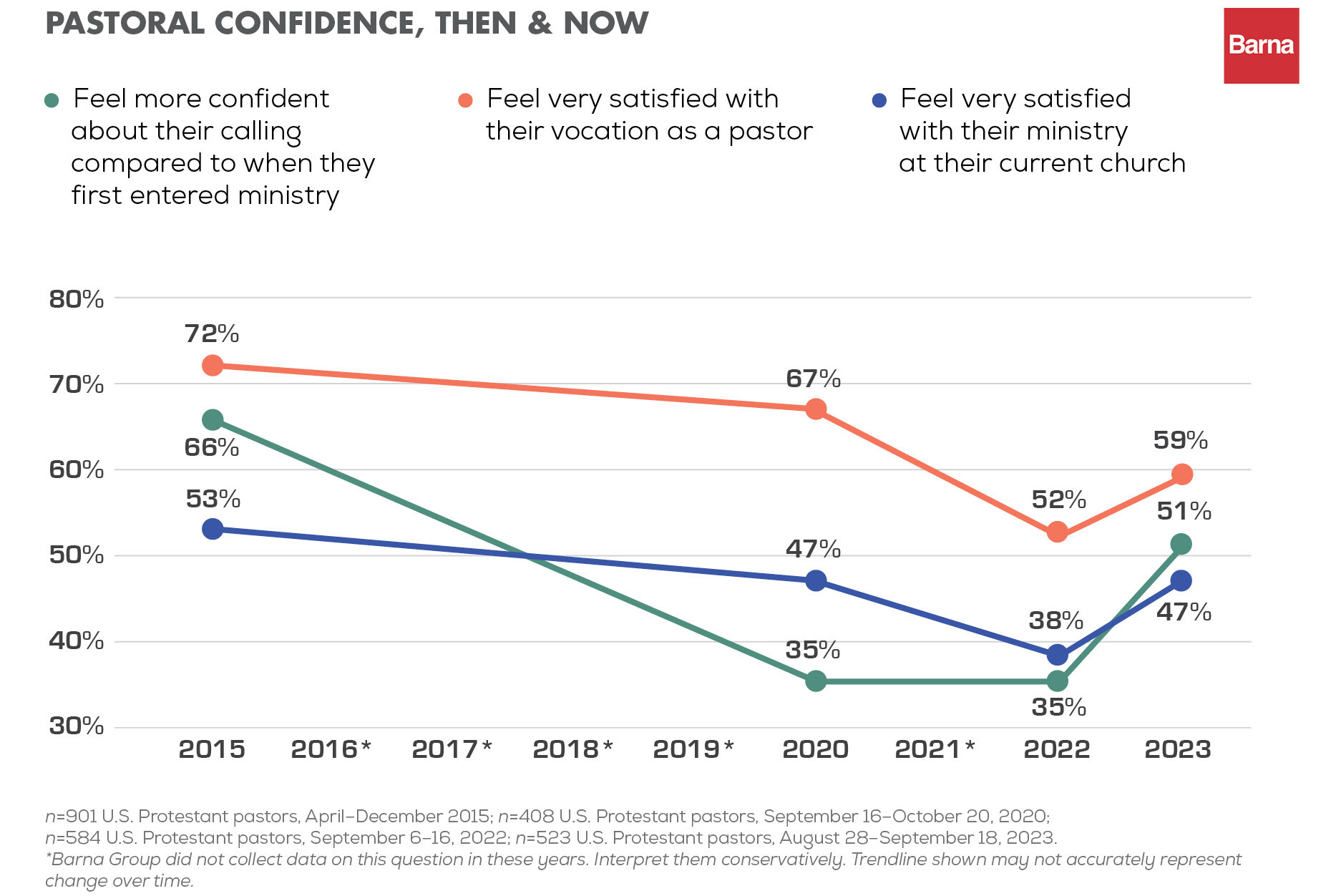
Later in 2023, Barna’s surveys of pastors looked a little different, a little more hopeful. It appears that pastors are regaining confidence. (Interestingly, Barna found that this correlates to their personal health.) The percentage who feel more positive about their calling increased by 16 percent over the last year.
Another remarkable finding is that experienced, older pastors demonstrate a resilience that younger pastors haven’t had the time yet to build. This may indicate a strong need for older pastors to mentor their younger counterparts.
The way out of a downturn in pastor well-being seems to be clearly marked. If the older pastors can mentor the younger, if church leaders and advisors will focus on the well-being of their senior pastors, we may see an increase in flourishing like we haven’t seen in the last decade. Who knows? Pastors who find the support they need may lead us in the next revival.
All infographics in this story come from and are used here with the permission of Barna Group.
 The freedom to ask God for big things
 AIMing for impact: A quick, simple method for giving decisions
 For the love of Zuni: John and Connie Moore’s story
 To educate a girl